Frequency
Daily
Dependency updates
check for new patch/minor versions, update, run tests, open PR if everything passes
Nightly test runs
full test suite against main to catch regressions early
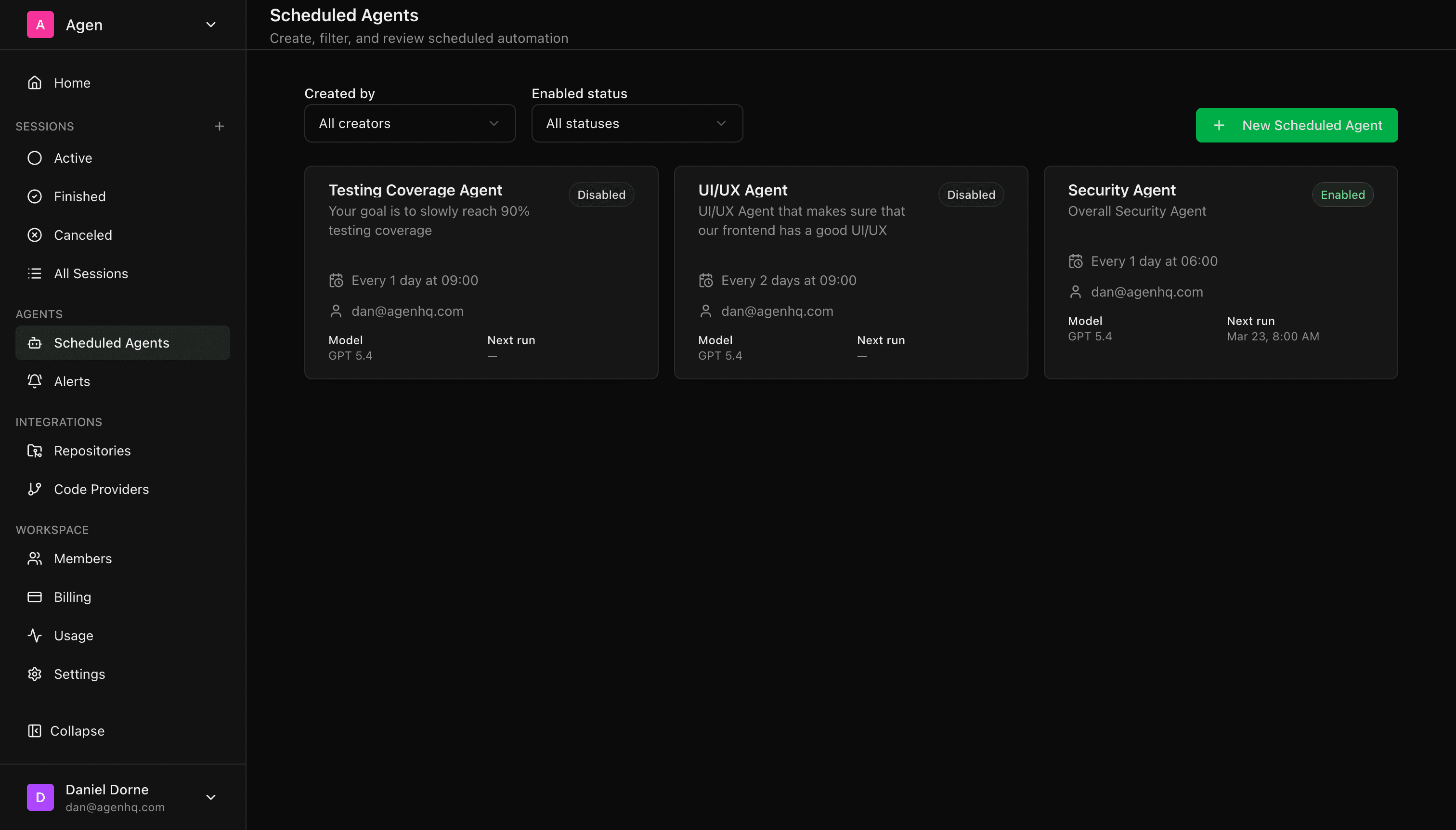
Set an agent on a recurring schedule with a budget limit. Dependency updates, test runs, security scans, performance audits — maintenance that runs itself.
Everyone knows these things need to happen regularly. Nobody prioritizes them because there's always a feature to ship.
So maintenance gets pushed until it turns into a production fire drill.
Patch and minor releases stack up while the team ships product work.
Nightly confidence disappears when nobody is regularly running the full suite.
Small regressions sneak in until the app feels slower and nobody knows when it started.
Everyone means to get to them later. Later usually arrives after something breaks.
Scheduled agents flip the model: maintenance just happens every night, every week, or every month — without anyone having to remember.
“Update all dependencies to their latest stable versions and run the test suite.” Plain English. Same as any Agen task.
Daily, weekly, monthly, or custom cron. Pick the frequency that matches the task.
Maximum spend per run. The agent stops when it hits the limit. No runaway costs — even if the task takes longer than expected.
At the scheduled time, the agent spins up, clones your repo, does the work, fixes any pipeline failures, and opens a PR.
A PR appears in your queue with a clean diff and passing CI. Review it over coffee. Merge or close. The next scheduled run happens regardless.
check for new patch/minor versions, update, run tests, open PR if everything passes
full test suite against main to catch regressions early
run load tests or benchmarks, flag regressions, open PR with findings
check for known vulnerabilities in dependencies, open PR with patches
compare code changes with docs, flag outdated sections
evaluate and upgrade major versions with migration changes
lint, dead code removal, import cleanup
scan dependencies for license changes
This is the feature Devin doesn't have.
When you schedule an agent, you set a maximum budget per run. This is a hard limit — the agent stops when it's reached, even if the task isn't finished.
A dependency update that usually costs $2 won't silently cost $50 if something unexpected happens
You can experiment with scheduled tasks without worrying about a surprise bill
Different tasks can have different budgets based on their expected complexity
If a run hits the budget limit before finishing, the agent stops and reports what it completed and what remains. You can increase the budget and re-run, or handle the rest manually.
$3/run budget
Usually finishes under $1.
$10/run budget
Occasionally needs more if patches are complex.
$25/run budget
Larger scope, higher ceiling.
| Tool | Scheduled agents? | Budget limits? |
|---|---|---|
| Agen | ✓ — Any frequency, any task | ✓ — Hard cap per run |
| Devin | ✓ — Recently launched | ✗ — No budget controls. Runs until done, bills per ACU. |
| Cursor | ✗ | ✗ |
| GitHub Copilot | ✗ | ✗ |
| Claude Code | ✗ | ✗ |
Devin launched scheduling recently — but without budget limits, a scheduled task that runs weekly can accumulate unpredictable costs. Agen's budget controls mean you know the maximum cost before the first run.
Scheduled agents work with multi-repo sessions. That means you can schedule a task like:
“Every Monday at 6 AM, update dependencies across frontend, backend, and infra repos. Run all test suites. Open linked PRs if everything passes.”
One schedule. Multiple repos.
Coordinated updates. Linked PRs.
Cross-Repository Live Preview of the integrated result.
No other tool can do this.
Set the schedule. Set the budget. The agent handles the rest.
$20 free credits · No credit card · No setup